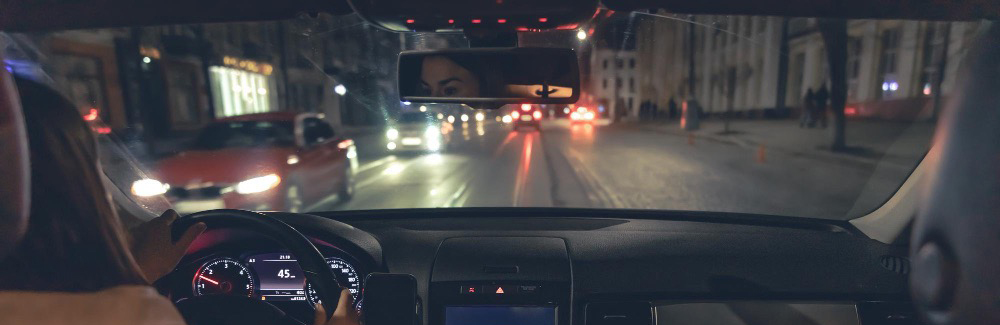
LED headlights and glare are important concerns for many patients who struggle with night driving. Their effects are especially noticeable as the eyes age. At Precision Eye Care, Dr. Romero helps patients understand how different light sources influence comfort, safety, and visual performance. Because LED lights are increasingly common, it is essential to know how they compare with older incandescent lighting.
Understanding LED Light Behavior and Its Impact on Vision
LED lights differ from incandescent bulbs in several key ways.
Their spectrum includes more short-wavelength blue light.
This type of light is more intense.
It is also more directional.
In contrast, incandescent bulbs offer a warmer, softer, and less focused output. [1][2][3][4]
Because LEDs emit concentrated beams, they may create sharper visual artifacts.
As a result, halos, glare, and visual discomfort are more common.
Additionally, LED headlights and glare often bother patients with early cataracts or intraocular lenses.
Why LED Headlights and Glare Matter for Night Driving
Research shows that LED sources are more likely to produce discomfort glare.
Their higher luminance increases perceived brightness.
Thus, glare becomes stronger when LEDs are not diffused or shielded.
Studies confirm that glare intensity depends on source luminance, background lighting, and viewing angle.[1][5][6][7]
Furthermore, halos can appear larger with LEDs.
This effect is linked to the strong directionality of the beam.
Eyes with age-related changes scatter more straylight.
Consequently, LED headlights can create more pronounced halos, especially in older adults or patients with implanted lenses.[8][9][10]
Color temperature (CCT) also plays a role.
Although CCT does not significantly affect disability or discomfort glare in healthy individuals, cooler, blue-rich LEDs may increase retinal stress in sensitive patients.[11][3][2]
In contrast, incandescent light produces smaller halos.
It also causes less discomfort because of its lower intensity and warmer spectrum.[1][4][3]
Reducing LED Headlights and Glare for Safer Night Driving
Visual performance may be reduced when LED glare is present.
This reduction becomes more evident while driving at night.
Older adults often notice these changes first.
Additionally, patients with cataracts or dry eye experience more intense halos.
Fortunately, modern LED technology can be optimized.
Good design significantly lowers glare.
As an example, high-quality diffusion systems soften beam edges.
Shielding also redirects excess brightness away from the eye.[5][7][6]
Because every patient’s eyes behave differently, the source of discomfort should be evaluated.
A complete exam with Dr. Romero helps determine whether cataracts, corneal changes, or pupil behavior contribute to glare sensitivity.
Key Takeaways for Patients
LED lights contain more blue light than incandescent bulbs.
They are more intense and more directional.
Halos and glare may become stronger with LED headlights.
Cataracts and implanted lenses increase sensitivity.
Incandescent lighting usually produces less glare.
Proper LED design can significantly reduce discomfort.
When to Schedule an Eye Exam
If night driving feels harder, it should not be ignored.
Trouble with LED headlights and glare may signal early cataracts, dry eye, or lens-related issues.
These conditions can be evaluated easily during a comprehensive exam with Dr. Romero.
Book Your Appointment at Precision Eye Care
Clear night vision is essential for safety and confidence.
If you struggle with glare, halos, or LED headlights while driving, we can help.
References
Light-Emitting Diodes (LEDS): Implications for Safety. Health Physics. 2020;118(5):549-561. doi:10.1097/HP.0000000000001259.
Effects and Mechanisms of Action of Light-Emitting Diodes on the Human Retina and Internal Clock. Touitou Y, Point S. Environmental Research. 2020;190:109942. doi:10.1016/j.envres.2020.109942.
Cytotoxicity and Genotoxicity of Light Emitted by Incandescent, Halogen, and LED Bulbs on ARPE-19 and BEAS-2B Cell Lines. Gea M, Schilirò T, Iacomussi P, et al. Journal of Toxicology and Environmental Health. Part A. 2018;81(19):998-1014. doi:10.1080/15287394.2018.1510350.
Light-Emitting Diodes (LED) for Domestic Lighting: Any Risks for the Eye?. Behar-Cohen F, Martinsons C, Viénot F, et al. Progress in Retinal and Eye Research. 2011;30(4):239-57. doi:10.1016/j.preteyeres.2011.04.002.
Model Predicting Discomfort Glare Caused by LED Road Lights. Lin Y, Liu Y, Sun Y, et al. Optics Express. 2014;22(15):18056-71. doi:10.1364/OE.22.018056.
Nighttime Driving: Visual, Lighting and Visibility Challenges. Wood JM. Ophthalmic & Physiological Optics : The Journal of the British College of Ophthalmic Opticians (Optometrists). 2020;40(2):187-201. doi:10.1111/opo.12659.
Thermal and Optical Design Analyses, Optimizations, and Experimental Verification for a Novel Glare-Free LED Lamp for Household Applications. Khan MN. Applied Optics. 2015;54(21):6566-74. doi:10.1364/AO.54.006566.
Assessment of Spectral Properties of Positive Dysphotopsia or Glare Caused by LED Sources for Different Types of Intraocular Lenses. Das KK, Kalapala AR. Optics Express. 2022;30(15):27140-27148. doi:10.1364/OE.465822.
Does Intraocular Straylight Predict Night Driving Visual Performance? Correlations Between Straylight Levels and Contrast Sensitivity, Halo Size, and Hazard Recognition Distance With and Without Glare. Ungewiss J, Schiefer U, Eichinger P, et al. Frontiers in Human Neuroscience. 2022;16:910620. doi:10.3389/fnhum.2022.910620.
Degradation of Visual Performance With Increasing Levels of Retinal Stray Light. van der Mooren M, Rosén R, Franssen L, Lundström L, Piers P. Investigative Ophthalmology & Visual Science. 2016;57(13):5443-5448. doi:10.1167/iovs.15-18514.
Glare at Night-Time Driving: Effect of Correlated Color Temperature of Led Lamps. Matesanz BM, Vicente EG, Issolio L, et al. Human Factors. 2025;67(6):578-594. doi:10.1177/00187208241305568.