


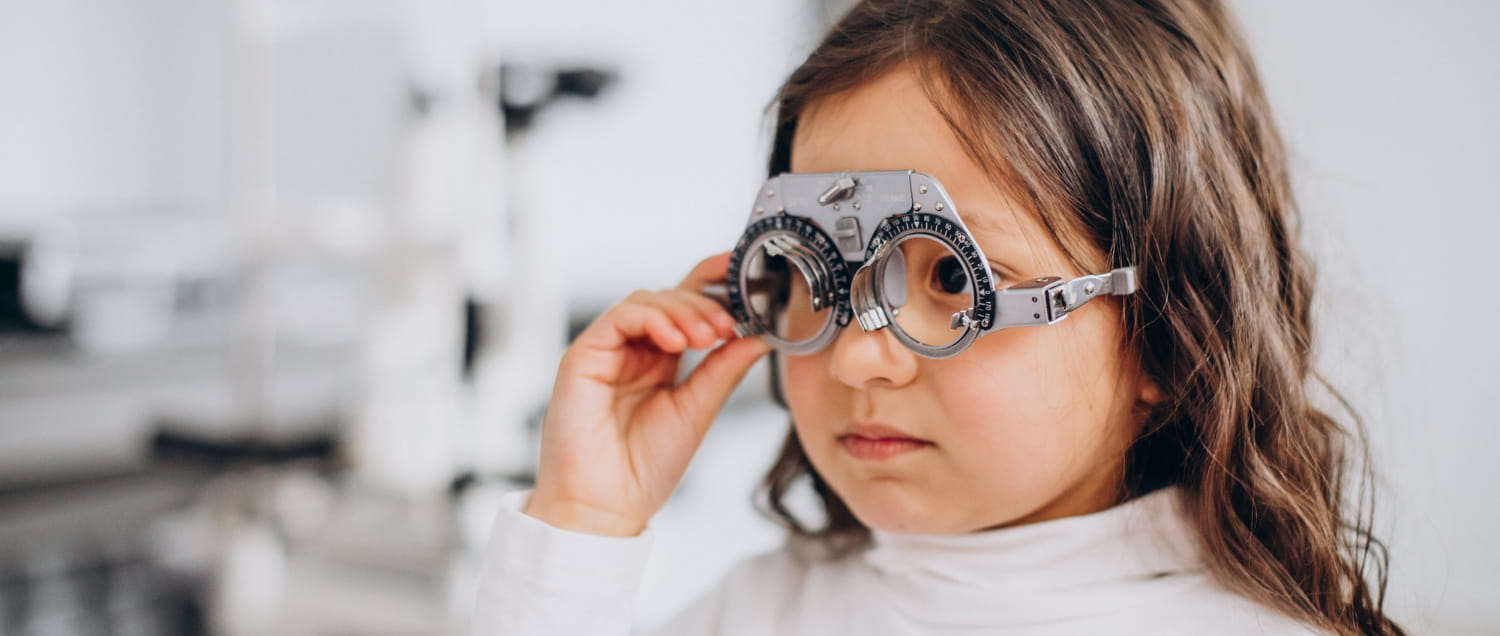
A new study identified a band of indigo light that suppressed myopia in an animal model. The finding is promising—but it is not yet a treatment for children.
Childhood myopia, or nearsightedness, is increasing rapidly worldwide. Researchers estimate that by 2050, nearly half of the world’s population may be myopic. This is not simply a matter of more children needing glasses. Higher levels of myopia increase the lifetime risk of retinal detachment, glaucoma, earlier cataract development, and myopic maculopathy.
For years, studies have shown that children who spend more time outdoors are less likely to develop
 However, we still do not fully understand why. Is the benefit related to the intensity of outdoor light? Looking at farther distances? Taking breaks from near work? Or could a particular component of sunlight help guide normal eye growth?
A study published in August 2026 in Cell Reports Medicine raises an intriguing possibility: a narrow band of indigo light that is present in sunlight—but poorly represented in many conventional LED systems—may help regulate the eye’s refractive development.
What is indigo light?
Visible light contains many wavelengths. In this study, researchers focused on short-wavelength light between approximately 419 and 446 nanometers, located between violet and blue on the visible spectrum.
This distinction matters. “Blue light” is a broad term that is often used loosely in advertising. The study does not show that all blue light protects against myopia, nor does it suggest that children should receive more light from screens or blue-colored lamps. The effect was observed within a specific wavelength range, delivered under controlled experimental conditions.
Sunlight contains this indigo band. Many conventional white LEDs, however, produce a peak near 450 nm along with substantial longer-wavelength light, while providing relatively little energy in the particular indigo range examined in the study.
What did the researchers find?
The investigators studied young tree shrews. Although tree shrews are not primates, they are commonly used in vision research because the structure and refractive development of their eyes share important similarities with human eyes.
The researchers placed a minus lens in front of one eye to create defocus and stimulate abnormal eye elongation—an established experimental method for inducing myopia. The other eye served as a control. They then exposed the animals to different lighting conditions and measured refractive changes and axial length.
When indigo light between 419 and 446 nm was added to a warm-white LED source, it completely suppressed the myopia normally induced by the minus lens. In other words, the eye exposed to defocus did not develop the expected myopic shift under those experimental conditions.
This is an important finding because myopia develops primarily when the eye grows too long. If a light signal can influence the retinal pathways that regulate this growth, environmental lighting could someday become a complementary strategy for preventing or controlling myopia.
How might it work?
The retina uses light for more than creating images. It also contains light-sensitive proteins called opsins, which participate in biological functions such as circadian regulation and may also influence eye development.
Earlier research in mice linked violet light near 380 nm to a nonvisual opsin called OPN5. The human crystalline lens, however, filters much of the radiation below 400 nm. Tree shrew lenses have a similar filtering effect, so the investigators looked for slightly longer wavelengths that could pass through the lens while still stimulating short-wavelength-sensitive retinal pathways.
The indigo band was the most effective range tested. OPN5 is one possible explanation, but the precise mechanism has not been established. Other opsins, retinal dopamine signaling, and interactions among light intensity, spectrum, and exposure duration may also contribute.
Does this mean indigo lamps can prevent myopia in children?
Not yet. This was a preclinical animal study, not a clinical trial involving children. The myopia was artificially induced with a minus lens and does not fully reproduce the combination of genetics, growth, accommodation, education, near work, and environmental behavior involved in childhood myopia.
Researchers also have not established an appropriate human “dose.” Identifying a wavelength is not enough. Future studies must determine the necessary intensity, daily duration, distribution of light, distance from the source, appropriate age of exposure, and the amount of light that actually reaches the retina.
Any lighting system intended for children would also need to demonstrate long-term ocular safety, visual comfort, and no harmful effects on sleep or circadian rhythms.
For these reasons, we do not recommend purchasing indigo lamps or attempting to create a home light treatment. Clinical trials and independent replication will be necessary before this approach can become part of routine myopia prevention.
It is also worth noting that two of the study’s authors are inventors on pending patents involving related lighting devices, and one is involved in a company developing this technology. This does not invalidate the findings, but it makes independent confirmation especially important.
Sunlight probably protects children’s eyes in more than one way
This study does not prove that insufficient indigo light is the sole cause of the worldwide rise in myopia. The outdoor environment differs from an artificially illuminated room in several important ways:
- Natural daylight is usually far more intense than indoor lighting.
- Children outdoors look across a wider range of distances and spend less time continuously focused at near.
- Sunlight changes in intensity and spectral composition throughout the day.
- Outdoor light may stimulate retinal dopamine pathways involved in controlling eye growth.
- Outdoor activities also interrupt prolonged screen use and other close visual work.
The protective effect of outdoor time is therefore likely multifactorial. The spectral composition of light may be an important new piece of the puzzle, but it does not replace everything the outdoor visual environment provides.
What can parents do now?
While we wait for human studies, families can rely on strategies that already have clinical support:
- Encourage safe, age-appropriate outdoor time every day.
- Build regular breaks into prolonged reading and screen use.
- Maintain a comfortable working distance and adequate lighting during near activities.
- Schedule routine eye examinations, particularly when one or both parents are myopic.
- Seek an evaluation if a child squints, sits unusually close to screens, cannot see the classroom board clearly, or needs frequent prescription changes.
- If myopia is progressing, speak with an eye doctor about established myopia-control options.
A new question about our indoor environments
Perhaps the most interesting contribution of this research is that it changes the question. We may need to consider not only how much light children receive, but also which wavelengths reach the retina, for how long, and at what stage of development.
This study does not mean that outdoor play can be replaced by a special lightbulb. It does remind us that children’s eyes evolved under full-spectrum sunlight—and that the design of schools, homes, and other indoor spaces could potentially influence visual development.
Indigo-enriched lighting is a promising and potentially scalable hypothesis. The next step is to determine whether it can be delivered safely and whether it actually reduces the onset or progression of myopia in children. Until then, it should be regarded as experimental research rather than an established treatment.
For families in Baltimore and surrounding communities, including Towson, Lutherville-Timonium, Pikesville, Roland Park, and Guilford, regular pediatric eye care can help identify changes in vision early and determine whether further evaluation is appropriate.
If you have concerns about your child’s vision, schedule a comprehensive eye evaluation with an experienced ophthalmologist who can assess your child’s visual development and discuss appropriate next steps.

